

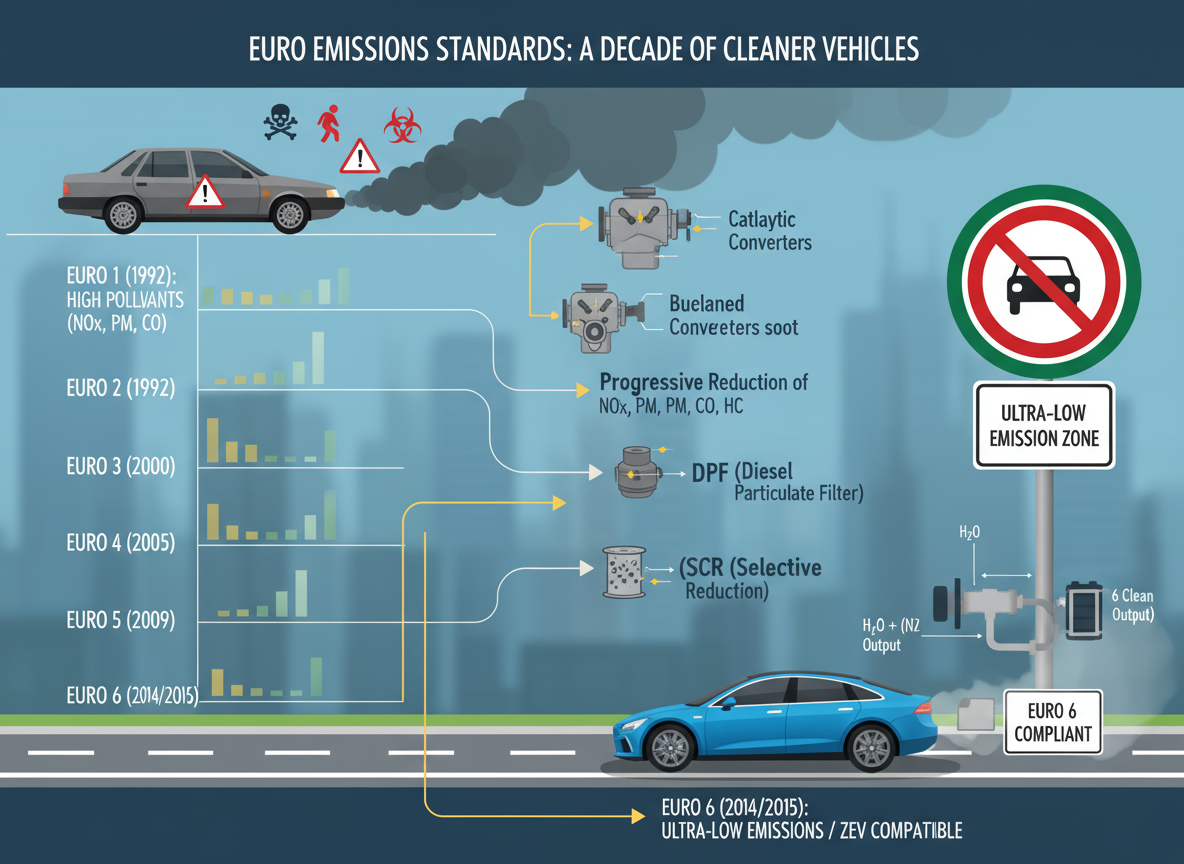
Cars don’t just carry people from A to B. They also carry invisible cargo: exhaust fumes. For decades, regulators have been battling to clean up that smoke, and the fight has centred on one system of rules, the Euro emissions standards.
These standards shape the engines built by every major manufacturer. They’re the reason your neighbour’s new hatchback comes with a complicated exhaust system, and why your trusty diesel might suddenly feel unwelcome in towns and cities.
If you’re wondering whether it’s time to scrap my diesel car, understanding Euro standards is the best place to start.
What exactly are Euro emissions standards?
Think of them as checkpoints on a long road. Every few years, the European Union introduced a stricter “Euro” stage, forcing car makers to reduce pollutants.
The pollutants measured include:
- Carbon monoxide (CO): A poisonous gas produced by incomplete combustion.
- Hydrocarbons (HC): Linked to smog and respiratory issues.
- Nitrogen oxides (NOx): Particularly harmful in diesel engines, contributing to acid rain and lung conditions.
- Particulates (PM): Tiny soot particles that lodge deep in the lungs.
Each Euro stage set tighter limits on those pollutants. By Euro 6, diesels had to slash NOx emissions by nearly 90% compared with the early 1990s.
Timeline of Euro standards, explained like a mechanic
Instead of dumping numbers, here’s what each stage meant in plain English.
- Euro 1 (1992): The first serious attempt to clean up exhausts. Catalytic converters became mandatory. Cars were still dirty, but it was a start.
- Euro 2 (1996): Reduced CO and HC further. Manufacturers had to adopt more precise fuel injection. Engines became a little cleaner, but not much.
- Euro 3 (2000): NOx became a bigger focus. This was the point when petrol engines got stricter fuel controls and diesels were pushed towards better combustion systems.
- Euro 4 (2005): Diesels exploded in popularity. Low road tax and high fuel economy made them attractive, but emissions were still high. Euro 4 cut NOx limits, though not enough to prevent the later backlash against diesels.
- Euro 5 (2009): Enter the Diesel Particulate Filter (DPF). These trapped soot, reducing particulates. Problem was, DPFs clogged on cars used for short trips. Drivers faced expensive repairs. I remember one chap who used his diesel for nothing but three-mile school runs. His DPF light was on more than it was off.
- Euro 6 (2014 onwards): The toughest yet. Diesels had to use AdBlue systems and selective catalytic reduction to cut NOx dramatically. Cleaner air, but more complexity. I lost count of the number of AdBlue-related faults that came through the garage.
Key point: Euro 6 is the current standard for compliance in most UK Clean Air Zones. Anything below it, especially diesels, faces penalties.
Why older diesels are being targeted
Diesel was once the “green” choice. Lower CO2 emissions meant cheaper tax. But NOx and particulates turned out to be the real villains.
- Diesels produce more NOx than petrol engines.
- They also release particulates unless fitted with a working DPF.
- City centres suffer most from these pollutants, hence the crackdown.
The irony is that drivers were encouraged into diesels in the 2000s, only to be punished for owning them a decade later.
LEZs, CAZs, and ULEZ: enforcement in action
Euro emissions standards are just rules on paper. To make them bite, cities enforce them through zones.
- LEZ (Low Emission Zone): Focuses mainly on heavy vehicles like buses and lorries. London’s LEZ covers the whole city.
- CAZ (Clean Air Zone): Targets everyday cars and vans. Birmingham, Bath, Bradford, and Glasgow all have CAZs in place.
- ULEZ (Ultra Low Emission Zone): London’s flagship scheme, charging £12.50 daily for non-compliant cars. Expanded zones now reach well beyond central London.
Case study: Manchester
A gardener I knew ran an old diesel Transit. Perfect for hauling tools. But when Manchester’s CAZ rules came in, he was suddenly paying £60 a week just in fees. Within a month, he admitted defeat and started looking at scrap options.
Case study: Birmingham
A taxi driver with a Euro 4 diesel Mondeo worked nights in Birmingham. When the CAZ launched, he calculated that within six months the charges would wipe out his profit. He used Sell a Vehicle to sell the car and upgraded to a compliant hybrid.
How Euro standards affect your wallet
The impact is more than just charges.
- Daily fees: £8–£12.50 per day soon adds up. Over a year, that could be thousands.
- Falling resale values: Non-compliant diesels are hard to shift. Buyers know they’re a liability.
- MOT tests: Emissions checks are stricter than ever. Failures are common, and repairs costly.
- Insurance premiums: Some insurers quietly raise rates for older diesels in ULEZ or CAZ areas.
I’ve seen solid cars, cars that once sold for £3,000, now struggle to fetch £500 because they’re Euro 4 diesels.
Should you scrap your diesel?
If you’re driving a pre-Euro 6 diesel, the question isn’t if the costs will hit, but when.
Ask yourself:
- How often do you drive into CAZ or ULEZ zones?
- Are you already paying daily charges?
- Is the car’s resale value collapsing?
- Are repair bills stacking up?
If you’re nodding to more than one, then it might be time to say: “It’s time to scrap my diesel car.”
You can get a scrap quote quickly and use the payout toward a cleaner replacement.
Alternatives to scrapping
Some drivers explore other options.
- Retrofitting kits: Add AdBlue or advanced filters. Costs thousands, approval limited.
- Re-mapping engines: Claims to reduce emissions, but not officially recognised. Can harm performance.
- Exemptions: Classic cars over 40 years old are exempt. Some councils offer discounts for residents.
In reality, these fixes rarely make sense for everyday drivers.
Environmental and health impact
The benefits of Euro standards are real.
- Cleaner cities: NOx and particulate levels have fallen since Euro 1.
- Health gains: Asthma rates and respiratory hospital admissions are lower where air is cleaner.
- NHS savings: Billions saved in reduced health costs.
But the cost is borne by drivers with older diesels.
Paperwork, DVLA, and selling tips
If you do decide to move on:
- Scrapping: You’ll need your V5C logbook, proof of ID, and must use an Authorised Treatment Facility. Our guide on what documents you need to scrap a car explains it step by step.
- Selling: A non-compliant car might still have value in regions without CAZs. Sell your car through our network and you could make more than the scrap value.
- Insurance: Once sold or scrapped, don’t forget to cancel your car insurance.
- Number plates: If you want to keep your registration, apply through DVLA. Our guide on keeping a private number plate explains how.
Anecdote: the Mondeo goodbye
One customer, a nurse, drove a diesel Mondeo for 15 years. It never let her down. But when London’s ULEZ expanded, she worked out that daily charges would outstrip the car’s value in 12 months. She came to me and said: “It’s time to scrap my diesel car. Feels like saying goodbye to an old mate.”
She scrapped it, pocketed the payout, and upgraded to a hybrid. Within weeks, she told me she felt liberated. No warning lights. No fines. Just peace of mind.
Next steps for drivers
If you’re weighing up options:
- Check your car’s Euro standard (on your V5C or online).
- Research the ULEZ in London or CAZ rules in your city.
- Calculate the yearly charges versus a replacement.
- See if exemptions apply.
- Get a scrap quote if your diesel has no future.
- Or sell your car if it still has value elsewhere.
Contact us for advice tailored to your situation.