

Scrapping a car isn’t as simple as handing over the keys and walking away. It’s closer to packing up a house move: plenty of details to double-check, paperwork to file, and loose ends you don’t want hanging around. One of the most important loose ends, and often the one people forget, is what happens to your number plates when scrapping a vehicle.
Those bits of plastic and aluminium aren’t just decoration bolted to the bumper. They’re the car’s official identity. If you leave them attached or fail to handle them properly, you could end up tied to parking fines, fraud investigations, or lose a personalised registration that could have been kept or transferred.
This guide walks through why plates matter, how to keep number plate when scrapping, what the DVLA requires, the mistakes drivers make, and the alternatives if you’re not sure scrapping is your best option.
Why Number Plates Matter When Scrapping
A car’s registration plate is its fingerprint. Forget about its colour, trim level, or the badge on the bonnet – what makes it traceable in law is the combination of characters on its plates. Those characters tie directly into:
- The DVLA database.
- Your V5C logbook.
- MOT history.
- Insurance record.
- Congestion charge and Clean Air Zone tracking.
Failing to deal with plates correctly when scrapping means all those systems could still think you’re responsible for a vehicle that no longer exists.
Risks of ignoring number plates when scrapping:
- Fines and penalties: Automatic cameras record the plate, not the driver. If your old plate ends up on another car, penalties could land on your doormat.
- Vehicle cloning: Criminals often fit stolen cars with cloned plates. It makes them harder to track and pushes the legal mess back onto you.
- Insurance complications: If the DVLA hasn’t updated the records properly, insurers may still show the vehicle active on your policy.
Mechanic’s anecdote: I once heard from a driver who left everything to the scrapyard, assuming “they sort it all.” A few weeks later, he was slapped with a bus lane fine from a city he’d never even visited. His plates had been bolted onto a similar car. It took him months of proving his innocence.
Key takeaways:
- Plates are the legal ID of your car.
- Leaving them unresolved can mean fraud, fines, and hassle.
- Handling them is as essential as securing your Certificate of Destruction.
Can You Keep Number Plate When Scrapping?
Yes, you can keep number plate when scrapping, but only if you apply before the car is permanently destroyed. Once the ATF issues a Certificate of Destruction and the vehicle is crushed, that registration dies with it.
For many, a private plate is more than a quirky identifier:
- Some see it as a personal investment.
- For others, it’s sentimental – tied to years of memories.
- Businesses may use plates as part of branding.
Losing one unnecessarily can be a costly mistake.
Examples from real drivers:
- A woman scrapped her Mini Cooper with the plate “M16 GNS” still attached. She thought the plate would “stay on record.” It didn’t. The plate was lost forever.
- A chap with the plate “B0B 77Y” applied for retention before scrapping. He moved it onto a new Defender, saving a plate he’d owned for years.
Key takeaways:
- Private plates can be retained or transferred, but only if you act early.
- Once scrapped, the number dies with the car.
- Treat your plate like a possession, not just an accessory.
How to Remove and Retain Your Number Plates
If you want to keep number plate when scrapping, there’s a precise process. Rushing it or assuming the yard will sort it leads to lost plates.
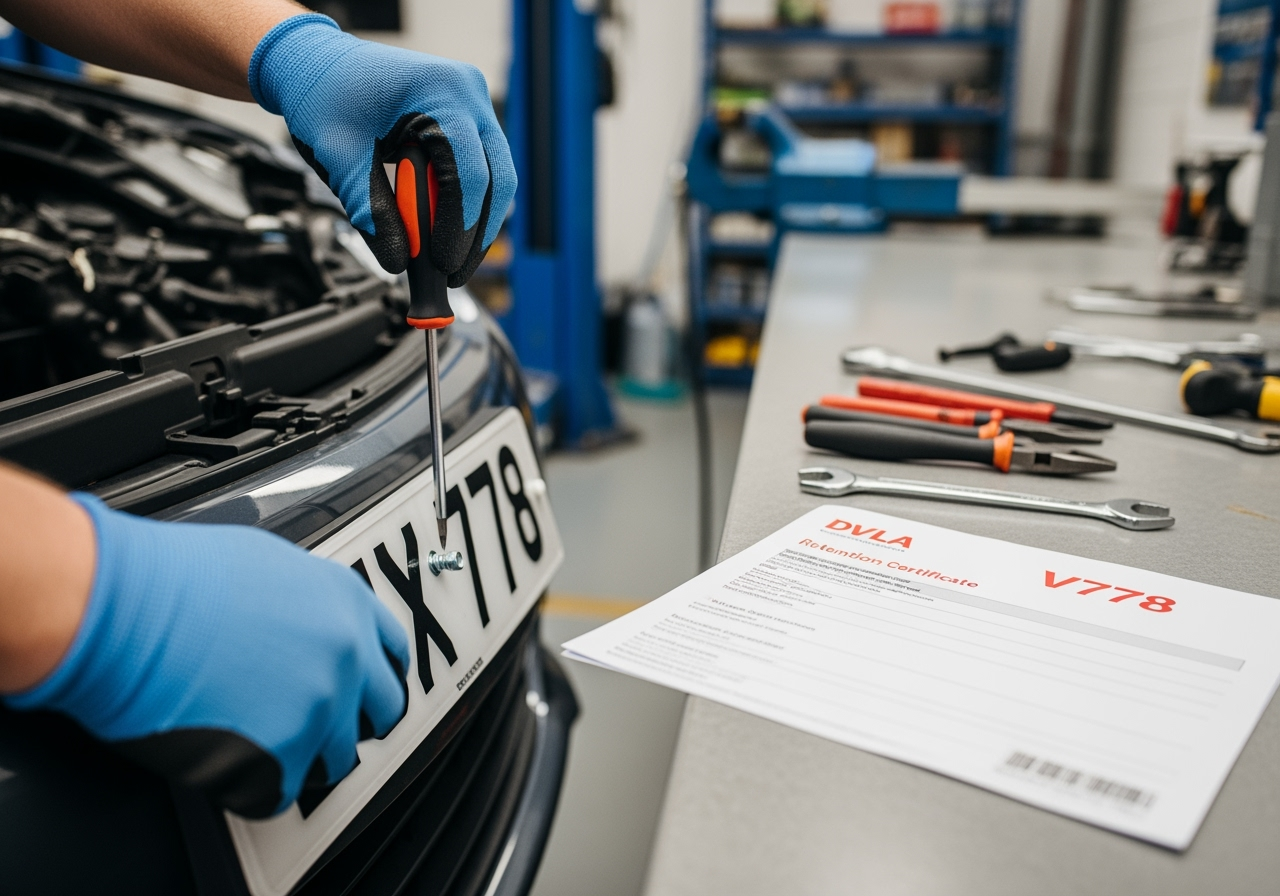
Step 1: Remove the plates yourself
- Plates are often fixed with screws, bolts, or adhesive pads.
- Use a screwdriver or trim tool. Be careful not to damage the plate itself.
- Do this before the collection truck arrives – once the car’s gone, so are your chances.
Step 2: Apply for retention
- Use the DVLA’s online service or submit form V317 by post.
- You’ll pay a standard fee of £80.
- If you apply online, approval is often instant.
Step 3: Receive your V778 Certificate of Entitlement
- The V778 proves you’ve retained the plate.
- It allows you to reassign it to another vehicle.
- Valid for 10 years and can be extended.
Step 4: Decide on its future
- Assign it straight away to another car.
- Or keep it on retention until you’re ready.
Key takeaways:
- Remove plates before scrapping.
- Apply through the DVLA – don’t rely on the yard.
- Keep your V778 safe; it’s as important as your logbook.
For more paperwork detail, see our guide on the documents needed to scrap a car.
The DVLA and Your Number Plates
The DVLA controls every element of plates and scrapping. Their responsibilities include:
- Updating records when cars are scrapped.
- Issuing Certificates of Destruction.
- Processing plate transfers and retention requests.
If you fail to notify them, you’ll remain tied to the car, sometimes financially. They also enforce rules on plate design, spacing, and age identifiers. For example, you can’t put a plate on a vehicle to make it appear newer than it really is.
Key takeaways:
- DVLA governs the plate retention system.
- Notification is your responsibility, not the scrapyard’s.
- Without proper DVLA approval, your plate is at risk.
What Happens to Standard Number Plates?
Not every driver wants to keep their plates. For those with standard-issue DVLA plates, the process is automatic.
Here’s what happens:
- The Authorised Treatment Facility (ATF) removes or destroys them.
- The DVLA updates the record to show the car is no longer in use.
- Because they were issued as part of the vehicle, they can’t be retained – they remain DVLA property.
Think of it like returning a library book. Once handed back, it’s not yours anymore.
Key takeaways:
- Standard plates are destroyed with the car.
- DVLA closes the record without extra input.
- No action is required if you don’t want to keep them.
Mistakes to Avoid When Scrapping with Number Plates
Even experienced drivers trip up when it comes to plates. Avoiding these mistakes will save you money and stress:
- Forgetting to remove the plates before collection.
- Failing to notify the DVLA.
- Assuming the scrapyard sorts retention automatically.
- Leaving the retention application too late.
- Losing the V778 Certificate.
Mechanic’s anecdote: A mate once assumed the yard would “hold onto” his private plate. He found out months later that it had been destroyed with the car. He’d owned it since his first vehicle, and losing it stung more than the car itself.
Key takeaways:
- Always remove plates yourself.
- Protect your documents like passports.
- Don’t rely on anyone else to safeguard your plate.
Alternatives to Scrapping: Selling Your Car
Scrapping isn’t the only path. Sometimes a car is worth more alive than dead. If it still runs, or even if it fails MOT but has desirable parts, selling could be the better option.
Through Sell a Vehicle, you can:
- Get a quick valuation.
- Connect with potential buyers.
- Sell even damaged or MOT-failed cars for more than scrap value.
Benefits of selling over scrapping:
- Often a higher payout than scrap.
- No need to apply for retention if the car remains in use.
- Extends the life of the vehicle or its components.
Regional differences:
- Manchester: Older diesels may be attractive outside the Clean Air Zone.
- London: ULEZ restrictions increase scrapping, but private buyers still exist.
- Birmingham: MOT failures are often sold on for parts demand.
For more insight, read how to keep your private number plate when selling a car.
Final Checks and Next Steps
Before you hand over your car, tick off these essentials:
- Remove your plates.
- Apply for retention if you want to keep them.
- Notify the DVLA.
- Get your Certificate of Destruction.
- Store your V778 securely.
You can get a quote to scrap your car through our trusted Authorised Treatment Facility network. If you’d rather test the market value first, find out how to sell your car.
For any queries or advice, contact us. The team’s on hand to help you every step of the way.