

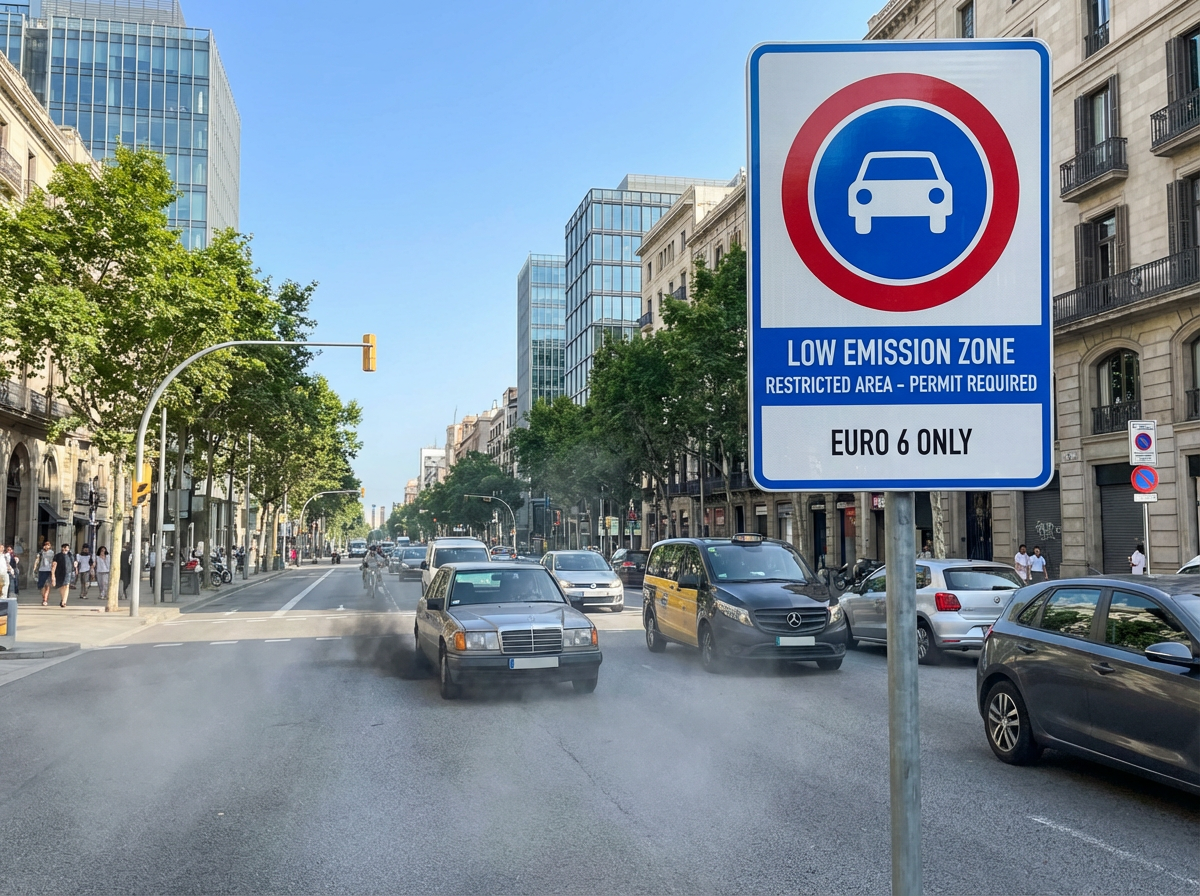
Back when I was a mechanic, nobody gave a second thought to emissions. If the car started in the morning and didn’t smoke like a chimney, you were good to go. Fast forward to today, and the rules of the road are changing quickly. UK city emission zones are now a fixture, and they’re hitting drivers of older vehicle emissions the hardest.
If you’ve got a faithful old motor that’s seen better days, you’ll want to understand how these zones affect you. The rules are strict, the fines are hefty, and the list of cities adopting them is growing every year. This guide will walk you through the basics, spotlight the five cities leading the way, and show you what practical steps you can take if your car is on the wrong side of compliance.
Emission zones explained in plain language.
Think of emission zones as toll booths, but instead of paying for the road itself, you’re paying because your car doesn’t meet modern emission standards. The principle is simple:
- Cleaner vehicles – free to enter.
- Polluting vehicles – pay a daily fee.
Depending on the city, these are branded differently:
- LEZ (Low Emission Zone) – aimed at cutting pollution from heavy vehicles.
- CAZ (Clean Air Zone) – broader, covering both cars and commercial vehicles.
- ULEZ (Ultra Low Emission Zone) – London’s tougher version.
- ZEZ (Zero Emission Zone) – the strictest, allowing only electric vehicles in some areas.
All serve the same purpose: to cut air pollution in busy city centres. But the way they’re enforced, and the vehicles targeted, can vary.
The top 5 UK cities with emission zones
London – the famous ULEZ
London’s Ultra Low Emission Zone (ULEZ) is the most well-known and strict on a large scale. Initially rolled out in central London in 2019, it has since expanded to cover almost the entire Greater London area.
- Daily charge: £12.50 for non-compliant vehicles.
- Fines: Up to £180 if you fail to pay.
- Coverage: Nearly all of Greater London.
ULEZ applies to both petrol and diesel cars, as well as motorbikes, vans, and lorries. For many London drivers, especially those with older diesels, this daily fee can quickly drain the bank balance.
If you’re based in the capital and own a non-compliant motor, you’ll want to consider your options. Selling might make sense; you can find out how to sell your car and avoid future headaches, or scrap your car if it’s beyond its useful life.
Birmingham – Clean Air Zone (CAZ)
Birmingham introduced its CAZ in 2021, covering the city centre inside the A4540 Middleway ring road.
- Daily charge: £8 for non-compliant cars and taxis.
- Target vehicles: Non-Euro 4 petrol and non-Euro six diesel.
- Purpose: To reduce nitrogen dioxide levels in one of the busiest city centres in the Midlands.
For many Brummies, this has been a sharp wake-up call. If you live in the area, especially with older diesels, it’s worth considering your next step. If you’d rather not fork out £8 a day, you could get a quote to scrap your car or look into a cleaner replacement.
Bath – the pioneer
Bath was the first city outside London to implement a CAZ back in 2021.
- Focus: Heavy goods vehicles, buses, coaches, taxis, and vans.
- Private cars: Currently exempt.
- Reasoning: Targeting the highest polluters first.
Even though private cars are spared for now, Bath’s bold move set a precedent. It showed smaller cities that they could take significant steps to clean their air. If you own a van or taxi and regularly travel through Bath, charges could add up quickly. For those drivers, selling through Sell a Vehicle might be the most straightforward route.
Bristol – catching up fast.
Bristol’s CAZ came into effect in late 2022. Unlike Bath, it includes private cars that don’t meet emissions standards.
- Standard: Petrol cars must meet Euro 4, diesels Euro 6.
- Charges: £9 daily for non-compliant private cars.
- Extra pressure: Narrow city streets make enforcement more important.
Many Bristol drivers have already chosen to sell their older motors rather than pay £9 a day. If you’re in the South West, you can find out how to sell your car quickly and safely through a trusted buyer, avoiding both the charges and the hassle.
Oxford – the strictest of the lot
Oxford has taken things further with the UK’s first Zero Emission Zone (ZEZ).
- Requirement: Only fully electric vehicles are free.
- Charges: Petrol and diesel vehicles, even hybrids, must pay to enter certain central streets.
- Future ambition: Expand restrictions and become a near-total zero-emission city.
This is a taste of what the future might look like across the country. For drivers of older vehicle emissions, it’s the starkest warning yet. At some point, even Euro 6 diesels may not cut it.
Which vehicles are in the firing line?
The cut-off points are broadly the same across most zones:
- Petrol cars: Must meet Euro 4 (2005 onwards).
- Diesel cars: Must meet Euro 6 (2015 onwards).
- Vans, lorries, buses: Varying but generally strict.
- Motorbikes: Some zones include them, others don’t.
Exemptions exist; classic cars, blue badge holders, and emergency vehicles are often spared. But for everyday drivers, the writing is on the wall: older vehicle emissions are being priced out of cities.
What happens if you ignore the rules?
Ignoring emission rules can be costly. Take London, for example:
- Drive a 2008 diesel into the ULEZ.
- The camera spots your number plate.
- System checks compliance.
- Days later, you receive a Penalty Charge Notice for £160 (reduced if paid early).
Fail to pay, and it escalates further. Unlike a parking warden, you can’t explain your way out of it. The system is automatic and unforgiving.
Selling your older vehicle: the thoughtful response
For many drivers, selling is the simplest solution.
- Financial sense: Daily charges add up fast. Selling gives you money for a compliant replacement.
- Environmental sense: Switching to a lower-emission or electric vehicle reduces your carbon footprint.
- Practical sense: No more fines, no more stress.
Sell a Vehicle makes this straightforward. Whether you want to sell your car or scrap it responsibly, you can arrange collection, get paid quickly, and move on without headaches.
Regional perspective: are you affected?
Emission zones aren’t just about London or Birmingham. They’re expanding across the UK. If you live in or near:
- Manchester – Plans for a CAZ delayed but expected. You can check Sell a Vehicle Manchester for updates and selling options.
- London – Already covered by ULEZ. Sell a Vehicle London supports drivers looking to switch.
- Birmingham – The CAZ is live. Sell a Vehicle Birmingham helps locals move on from older diesels.
Regional services make it easier for drivers in affected cities to sell or scrap without stress.
Alternatives if you don’t want to sell
If selling isn’t for you, there are other ways to adapt:
- Switch to public transport – Cheaper than paying daily fees.
- Cycle or walk – Healthy and free.
- Use Park & Ride – Park outside the zone and bus in.
- Car share – Travel with someone whose vehicle is compliant.
Sometimes the best fix isn’t under the bonnet. It’s rethinking how you get from A to B.
The bigger picture: the future of emission zones
The five cities we’ve looked at are only the beginning. Across the UK, councils are under pressure to reduce pollution. Expect:
- More CAZ schemes in smaller towns.
- Tougher standards over time.
- Wider coverage areas.
Scotland already runs LEZs in cities like Glasgow, and other countries are ahead of the curve. The direction of travel is clear, zones are spreading, and standards are tightening.
The decision for older car owners
If you drive a pre-2006 petrol or pre-2015 diesel, you’re at a crossroads:
- Keep it: Accept the daily charges.
- Sell it: Cash in while you can still get a fair price.
- Scrap it: If it’s truly end-of-life, scrap responsibly with proper paperwork (see our guide on scrapping documents).
- Upgrade: Move to something compliant or electric.
Don’t forget, once you’ve sold or scrapped your car, you’ll need to handle the admin. Our guide to cancelling car insurance will help you avoid paying for cover you no longer need. And if your vehicle has a private plate you’d like to keep, we’ve explained how to transfer your plate when selling.
A quick story to round it out
Years ago, I had a customer with a trusty Peugeot 307 diesel, solid runner, nothing fancy, but reliable as the sunrise. When ULEZ expanded, he found himself paying £12.50 a day just to see his daughter in London. After a few months, he’d spent more on charges than the car was worth.
He decided to sell through a quick online buyer, put the money towards a compliant hybrid, and later told me it was one of the best decisions he’d made. No more fines, no more worry, just freedom to drive wherever he needed. That’s the reality for many drivers today; sometimes the emotional pull of keeping a car has to give way to practical sense.