

If you’re still driving an older petrol or diesel car, you’ve probably noticed the world is starting to push back. Clean Air Zones are spreading, Ultra Low Emission Zones are charging daily, and fuel costs never seem to go down. The message is clear: older motors aren’t welcome on the road like they once were.
But there’s a positive side. If you know how to work the system, you can claim a scrappage scheme discount and put that money towards a cleaner replacement. The process isn’t complicated once you break it down. With the right steps, a bit of inside knowledge, and a touch of negotiation, you can make sure you’re not leaving money on the table.
Why scrappage schemes exist and why they matter
Scrappage incentives go back further than you’d think. The most famous one was the 2009 UK Government scheme that offered £2,000 off new cars if you traded in an old one. That was all about keeping factories running during a financial slump.
Today’s schemes are different. They’re built around public health. Councils and government departments are trying to clean the air by encouraging drivers to swap old, smoky cars for cleaner models.
It works like this:
- The carrot: a cash grant or scrappage scheme discount on a newer, compliant vehicle.
- The stick: daily CAZ or ULEZ charges for non-compliant cars, often between £8 and £12.50.
For drivers, that choice comes down to whether it’s cheaper to pay charges or upgrade with financial support. For councils, it’s a way to reduce pollution without banning cars outright.
Why it should matter to you:
- If you drive into a Clean Air Zone regularly, charges mount up quickly.
- Scrapping or selling early often secures a better price before values drop.
- Non-compliant cars will only depreciate further as restrictions tighten.
If you’re unsure whether selling might be the better move, you can find out how to sell your car through Sell a Vehicle for a fast comparison.
Clean Air Zones vs ULEZ: clearing the fog
It’s easy to get lost in the acronyms, so here’s the stripped-down version from the garage floor.
- Clean Air Zones (CAZ): These vary by city. Birmingham, Bath, and Portsmouth already have them in place. Some target taxis, buses, and lorries, while others include private cars.
- Ultra Low Emission Zone (ULEZ): London’s stricter version. Almost every non-compliant car is charged £12.50 per day, and the zone has expanded well beyond central London.
Analogy: Think of a CAZ like a simple service check, oil, tyres, brakes. ULEZ is a full inspection with every bolt tightened and every filter checked. If your car doesn’t meet the emissions standard, you’re paying for it daily.
Tip: Always use the Transport for London or local council website tools to check your car before assuming it’s safe. I once had a neighbour who bought a 2010 diesel thinking it was compliant. A quick check proved otherwise, and within a week he was out of pocket on daily charges.
If you’re in a city like Manchester, you can even check our regional service to see the options available in your area.
Is your vehicle affected?
This is usually the first stumbling block. A rough guide is:
- Petrol cars: Pre-2006 models are usually non-compliant.
- Diesels: Pre-September 2015 tend to fail.
- Motorcycles: Anything pre-2007 often struggles.
These are only broad rules, though. To be certain:
- Look up your Euro emissions standard on your V5C or online.
- Use local council compliance tools like those in Birmingham or Bath.
Anecdote: I once dealt with a chap who thought he’d beaten the system with a 2007 petrol estate. Trouble was, it was registered just before Euro 4 came in. He was stung by daily ULEZ charges and was back in my garage a fortnight later asking about scrappage options.
For drivers in London, it’s worth double-checking directly against the Transport for London system, as the city has some of the strictest rules.
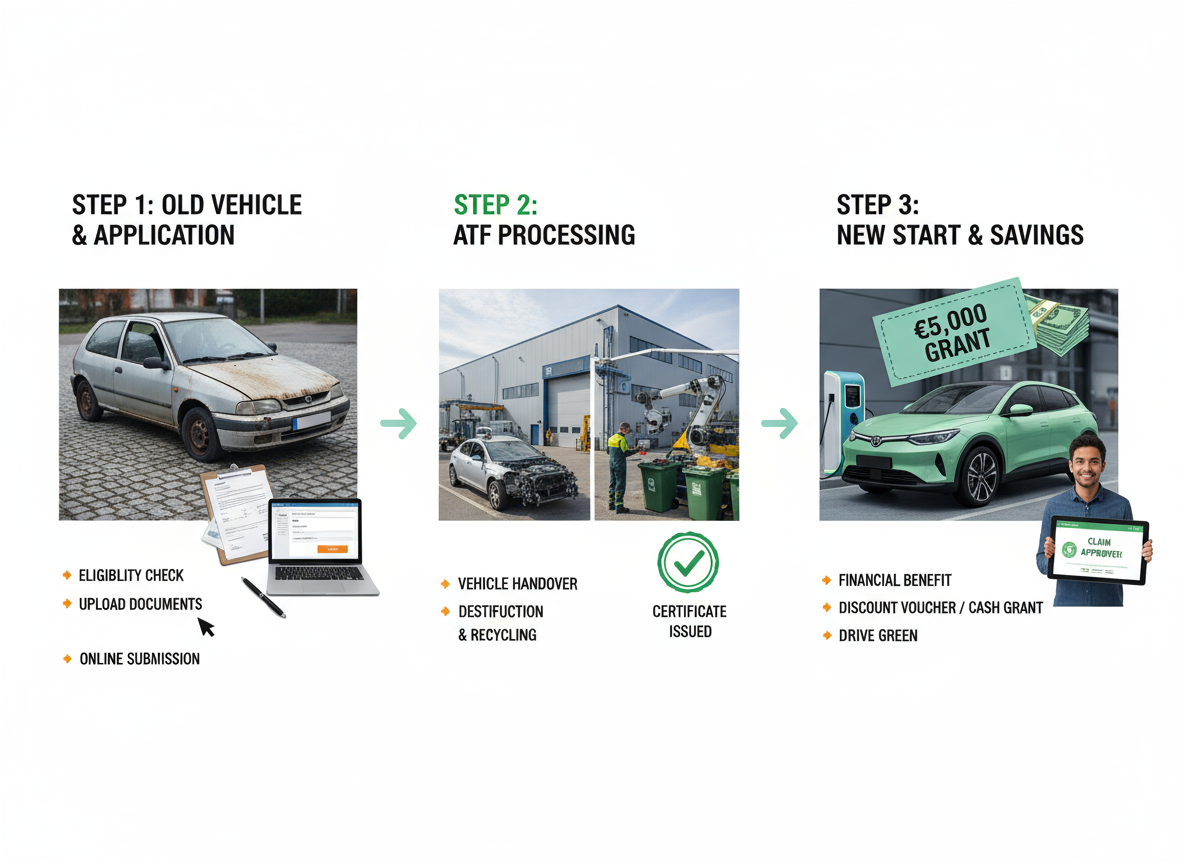
Step-by-step: how to claim scrappage scheme discounts
The process shifts slightly between councils and carmakers, but here’s the general blueprint:
Step 1: Research schemes
- London runs the most generous ULEZ scrappage scheme.
- Birmingham and Greater Manchester have their own versions.
- Manufacturers like Ford, Kia, and Toyota sometimes offer independent incentives.
Step 2: Confirm eligibility
Typical requirements include:
- Vehicle age and emissions standard.
- Proof you’ve owned the car for at least 12 months.
- Proof of address in a CAZ or ULEZ zone.
- For businesses and charities, vans and minibuses may qualify.
Step 3: Apply online
Applications usually ask for:
- V5C logbook.
- Proof of address (council tax, utility bill).
- Insurance certificate.
Step 4: Get your car valued
Some schemes set a fixed amount, while others allow valuations. Compare multiple offers if possible.
Step 5: Scrap at an Authorised Treatment Facility (ATF)
Only ATFs can issue the Certificate of Destruction (CoD). Without it, you can’t claim.
Step 6: Claim your scrappage scheme discount
Once the CoD is submitted:
- Grants may be deducted from the price of a new car.
- Or funds may be paid directly to you.
Processing times differ, but London’s ULEZ scheme can take up to two months.
Tips to maximise your scrappage benefit
With years of watching drivers make the same mistakes, here’s what I’ve learned about squeezing the most out of scrappage schemes.
- Get multiple valuations if the scheme allows it.
- Look out for manufacturer top-ups. Ford’s 2020 plan offered up to £2,000 extra.
- Negotiate with dealers. They’re often happy to reduce prices further when they know scrappage money is guaranteed.
- Compare against selling. Use Sell a Vehicle to weigh up if selling privately through us is more profitable than a fixed scrappage payout.
Case anecdote: Mrs Higgins almost scrapped her Fiesta for £1,500 under a council plan. A quick Sell a Vehicle quote landed her £1,950 instead. She bought a compliant car, avoided ULEZ charges, and had a little more left in her pocket.
Selling as an alternative to scrappage
Scrappage isn’t always the winner. Depending on the car and market conditions, other routes can pay better.
- Private sale: Highest return, but you handle the advertising, test drives, and paperwork.
- Dealer trade-in: Simple, quick, but usually the lowest value.
- Online buyers like Sell a Vehicle: A balanced option. Fair price, quick turnaround, and free collection.
Sometimes a car that looks like a scrapper can still fetch more if sold properly. That’s why getting a quote to scrap your car alongside a sale price quote makes sense.
What happens when your car is scrapped?
Scrapyards aren’t as brutal as the old car-crusher films suggest. ATFs take a measured approach:
- Hazardous fluids, oils, and batteries are drained.
- Reusable parts are removed and resold.
- The rest of the body is shredded and recycled.
Your old car could end up as scaffolding, part of another vehicle, or even a washing machine. In the process, you’ll receive a Certificate of Destruction confirming it’s off the road legally.
For guidance on the paperwork side, you can check our guide on the documents needed to scrap a car.
Extra considerations: what happens after scrapping?
Scrappage schemes don’t end with handing in your car. You’ll need to tie up a few loose ends:
- Cancel your insurance. Otherwise, you’ll be paying for cover you don’t need. Our step-by-step guide to cancelling car insurance explains the process.
- Keep or transfer your number plate. If you’ve got a private reg, follow our number plate guide before sending your car off.
- Confirm DVLA updates. Make sure the car is marked as scrapped to avoid tax or SORN issues.
Claim scrappage scheme: summary
Here’s the process in simple order:
- Confirm your Euro emissions standard.
- Research council and manufacturer schemes.
- Apply with the correct paperwork.
- Scrap at an ATF and get your Certificate of Destruction.
- Claim your scrappage scheme discount or compare against selling options.
Next steps
- Use DVLA or TfL tools to check if your car is compliant.
- Research scrappage schemes with both councils and manufacturers.
- Get a Sell a Vehicle quote to see if selling offers a better return.
- If scrapping, don’t forget to cancel your car insurance.
- Contact us if you’d like advice on which route will leave you better off.