

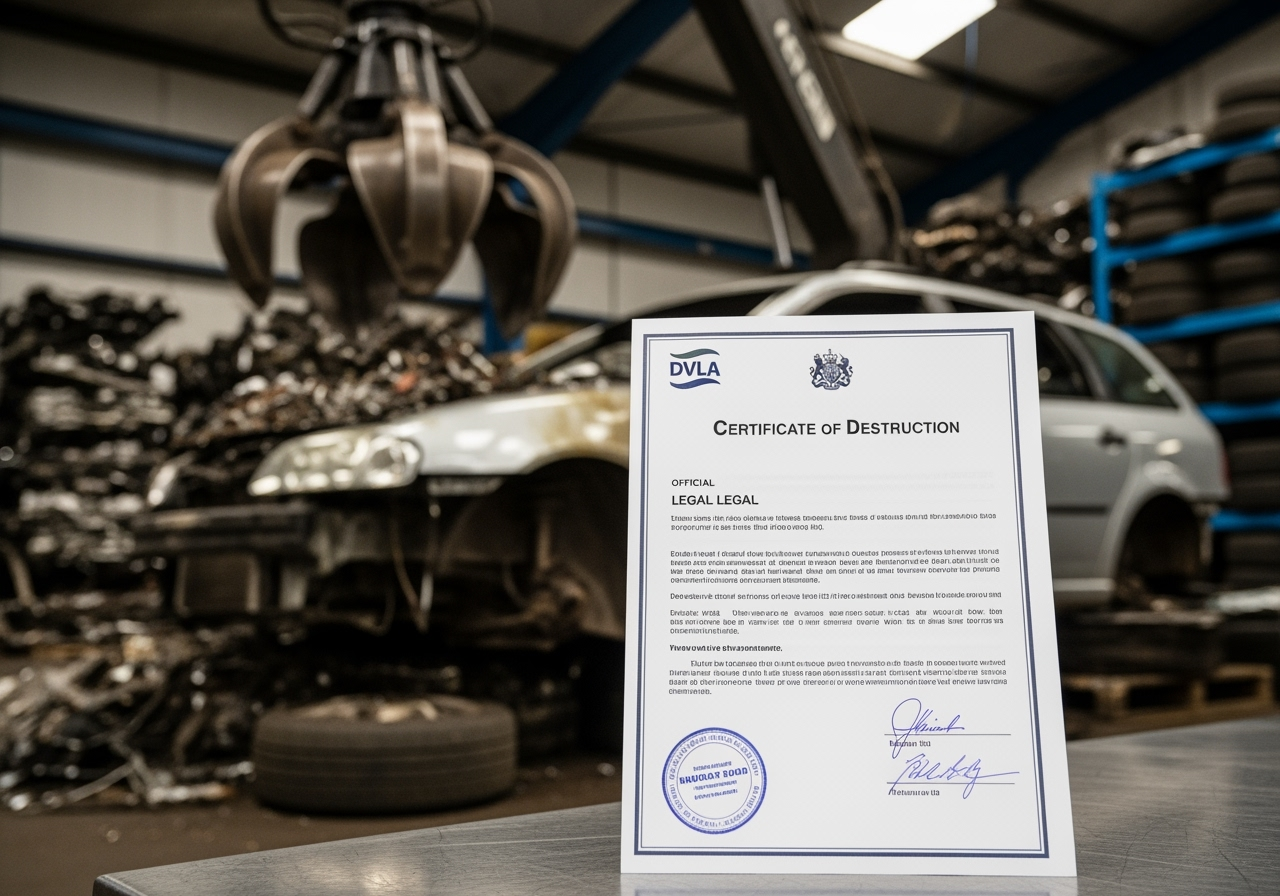
Scrapping a car isn’t just about waving it goodbye as a recovery truck pulls off down the street. There’s more to it than handing over the keys and breathing a sigh of relief. One document matters more than any other – the Certificate of Destruction.
This certificate isn’t just a scrap of paper to file away. It’s the legal proof from the DVLA that the vehicle is gone for good. It ends responsibility for the registered keeper, wipes their name from the records, and ensures the car won’t reappear somewhere it shouldn’t.
Skip this step, and the risks are real. Some motorists have been hit with road tax demands, speeding fines, and even insurance problems because they failed to obtain the right paperwork. One local case involved a driver who scrapped his Fiesta at a back-alley yard without a proper car scrapping certificate. Months later, fines piled up because the car had been patched back together and sold on. That entire mess could have been avoided with a single document.
That’s why the Certificate of Destruction is essential. It’s more than admin; it’s protection against future hassle.
What is a Certificate of Destruction?
A Certificate of Destruction (CoD) is an official DVLA document confirming a vehicle has been permanently scrapped. It is only issued by an Authorised Treatment Facility (ATF) – scrapyards licensed by the Environment Agency or the Scottish Environmental Protection Agency.
The certificate proves three crucial things:
- The vehicle has been dismantled and destroyed according to environmental rules.
- The registered keeper is no longer legally responsible.
- The vehicle has been permanently removed from the road and cannot be resold.
It is, in simple terms, the car’s death certificate. Until the DVLA receives confirmation, the keeper remains responsible. That means tax, fines, and liability continue until the CoD is processed.
The legal background of Certificates of Destruction
The car scrapping certificate is rooted in legislation, not optional paperwork. It was introduced as part of the EU End-of-Life Vehicles Directive (2000/53/EC), and was later incorporated into UK law.
The rules were designed to address environmental and consumer risks linked to unregulated scrapping. They ensure:
- All end-of-life cars go through ATFs.
- Hazardous fluids, batteries, and parts are removed safely.
- Vehicles are recycled rather than abandoned.
- Owners are shielded from the dangers of unlicensed yards.
Before this system, it wasn’t unusual to see abandoned shells leaking fluids into the ground. The CoD requirement was introduced to eliminate that risk and keep disposal accountable.
Why can only Authorised Treatment Facilities issue a CoD
Only ATFs can issue a Certificate of Destruction. A cash-in-hand deal with a backstreet yard might seem appealing, but without an ATF licence, they cannot provide legal proof.
ATFs follow a strict process before issuing a car scrapping certificate:
- Depollution – fluids like oil, coolant, and fuel are drained safely.
- Hazard removal – batteries, tyres, and airbags are removed responsibly.
- Recycling – metals and plastics are stripped and processed for reuse.
- Reporting – details are sent electronically to the DVLA, which then generates the CoD.
One example involved a driver who proudly accepted cash for an old Rover at a non-authorised yard. No certificate was provided. Within weeks, fines linked to the vehicle began arriving because the car had been sold illegally. The absence of a CoD left the keeper exposed.
Key takeaways:
- Only ATFs can issue Certificates of Destruction.
- ATFs are legally bound to recycle responsibly.
- Backstreet yards cannot provide legal proof, so they should be avoided.
Why is a Certificate of Destruction important?
Without a CoD, the DVLA still considers the registered keeper responsible. That liability doesn’t end when the vehicle leaves the driveway.
Risks of not having a CoD include:
- Ongoing road tax bills.
- Insurance liability, even after the car is gone.
- Potential legal trouble if the vehicle is resold or used in a crime.
- Uncertainty over whether it was scrapped properly.
The CoD is effectively a resignation letter from ownership. Without it, responsibility continues indefinitely.
Peace of mind and protection
Beyond the legal and financial angles, the Certificate of Destruction offers peace of mind. It guarantees that:
- The car will not be patched up and resold unsafely.
- It won’t be used for illegal activities.
- All toxic materials have been handled responsibly.
A valid CoD provides certainty that the vehicle has been dealt with correctly and permanently.
Step-by-step: how to get a Certificate of Destruction
Obtaining a CoD is simple when using an ATF.
- Get a quote – services like Sell a Vehicle’s scrap car tool give quick valuations.
- Confirm ATF status – check the facility’s authorisation on GOV.UK.
- Arrange collection or delivery – many ATFs collect vehicles free of charge.
- Provide paperwork – usually a V5C logbook and proof of ID.
- Vehicle processed – fluids are drained, hazards removed, and dismantling begins.
- Certificate issued – generated electronically and usually received within days.
Check the certificate includes:
- Registered keeper details.
- Vehicle registration number and VIN.
- Date of destruction.
The certificate should always be kept safe, as it is the only proof of protection.
What if you don’t receive a CoD?
Delays are possible, but missing paperwork must never be ignored.
If the car scrapping certificate doesn’t arrive:
- Contact the ATF – often it’s an admin delay.
- Chase in writing – written proof helps if escalation is required.
- Report non-compliance – raise concerns with the DVLA or Environment Agency.
In one neighbourhood example, a driver who scrapped a Mini with a licensed ATF received the CoD promptly. A friend who used a non-authorised yard never received one, and months later was still facing tax demands. The difference was clear: only the ATF can provide the legal protection.
Common myths about Certificates of Destruction
A few widespread misunderstandings often cause trouble:
- “Old cars don’t need one.” False – all scrapped vehicles require a CoD.
- “A receipt is enough.” False – receipts aren’t recognised by the DVLA.
- “It can be issued later.” False – only the ATF that dismantled the car can issue it.
- “Selling a car gets a CoD.” False – certificates only apply to scrapping, not sales.
Certificates of Destruction and scrapping for parts
Stripping parts before scrapping is common, but the CoD rules still apply:
- If the remaining shell is sent to an ATF, a CoD will still be issued.
- Selling a car as “spares or repair” does not result in a CoD – that’s a sale, not scrapping.
- Dismantling a car privately doesn’t generate a CoD – only ATFs can.
The final shell must always go through an authorised facility to trigger the certificate.
The future of Certificates of Destruction
The DVLA is moving towards a fully digital process.
- Certificates will be stored online for easy verification.
- DVLA records will be updated automatically.
- Fraud and fake certificates will be harder to produce.
For motorists, this means quicker confirmation and less paperwork.
Regional differences in scrapping and CoDs
While CoD rules are the same across the UK, regional conditions affect the scrapping market.
- London – ULEZ rules push more vehicles into scrappage.
- Manchester – competition between ATFs often results in higher quotes.
- Birmingham – large industrial yards dominate, though CoD rules remain identical.
Services like Sell a Vehicle in Manchester, Sell a Vehicle in London, and Sell a Vehicle in Birmingham make it easy to compare regional options.
Environmental Benefits of Certificates of Destruction
The CoD system directly supports environmental protection:
- Toxic materials are removed safely.
- Valuable metals and plastics are recycled.
- Waste going to landfill is minimised.
Each certificate ensures that another vehicle has been responsibly disposed of rather than abandoned or exported illegally.
Real-life case examples
- Case 1: A driver scrapped his vehicle at a licensed ATF and received the CoD within days. No issues followed.
- Case 2: A neighbour used an unlicensed yard. No CoD was issued. Months later, fines linked to the vehicle started arriving.
A single piece of paperwork dictated the outcome.
Final thoughts
The Certificate of Destruction is the cornerstone of responsible scrapping. It protects against liability, ensures environmental compliance, and confirms that a vehicle has been removed from the road permanently.
Always insist on one, always use an ATF, and always keep it safe. Without it, the risks linger long after the car is gone.
For end-of-life vehicles, get a quote to scrap your car with Sell a Vehicle’s trusted network. If a car is still in running condition, it may be better to sell your car. For questions or advice, it’s always possible to contact us.